
Blog

  • UP Scholarship 2026: Last Date, Eligibility, Status Check & Latest Updates

    UP Scholarship 2026: Last Date, Eligibility, Status Check & Latest Updates

    If you work closely with students and middle-income families in India, you already know this: scholarship money isn’t “extra support.” For many households, it’s the difference between continuing education and dropping out quietly.

    Every year, I see parents take short-term loans at 18–24% interest just to pay school or college fees while waiting for scholarship credits. Most don’t even know how the UP Scholarship process actually works. They just apply, wait, and hope.

    URGENT UPDATE (Feb 17, 2026): If you made corrections to your 2025-26 scholarship form during the recent window, you must submit the printed hard copy to your college by February 18, 2026. This is a mandatory step for physical verification. Without this, your application will be rejected at the institutional level.

    Let’s clear that confusion.

    This detailed guide on UP Scholarship 2026 covers the last date, eligibility criteria, status check process, renewal updates, and common mistakes — explained in practical, real-world terms.

    What Is UP Scholarship 2026?

    It is administered through the Social Welfare Department of Uttar Pradesh via the official scholarship portal. and funds are disbursed through the Direct Benefit Transfer (DBT) system.

    The UP Scholarship is a financial assistance scheme run by the Uttar Pradesh Government to support students from economically weaker and socially disadvantaged backgrounds.

    It generally covers:

    • Pre-Matric (Class 9–10)
    • Post-Matric (Class 11–12)
    • Undergraduate (BA, BSc, BCom, etc.)
    • Postgraduate (MA, MSc, MCom)
    • Professional Courses (Engineering, Medical, Management, etc.)

    The objective is simple: reduce financial pressure so students can complete their education.

    But the implementation is where timing, documentation, and verification matter more than most people realize.

    UP Scholarship 2026: Important Dates (Expected Timeline)

    While official dates are announced each academic cycle, based on previous academic cycles and notification trends, here’s what typically happen.

    UP Scholarship Official Dates (2025-26 Cycle):

    • Online Correction Window: Closed on February 13, 2026

    • Hard Copy Submission to College: February 18, 2026 (Last Date)

    • Re-Scrutiny by NIC: February 19 – February 27, 2026

    • Data Locking by District Committee: March 10, 2026

    • Final Payment Disbursement (DBT): March 18, 2026

    • Next Session (2026-27) Registration: Expected July 2026

    In my experience, students who apply within the first 30–45 days face fewer technical issues. Last-week applications often run into server slowdowns or document mismatch problems.

    And yes, I’ve seen students miss out simply because they waited till the last 48 hours.

    UP Scholarship 2026 Eligibility Criteria

    Eligibility for UP Scholarship 2026 depends on category, family income, domicile status, and academic progression. Each condition is verified at multiple levels, so accuracy in documentation is critical.

    1. Domicile Requirement

    The applicant must be a permanent resident of Uttar Pradesh. A valid domicile certificate may be required during verification.

    2. Category-Based Eligibility

    The scholarship is generally available to students belonging to:

    • SC / ST
    • OBC
    • General (Economically Weaker Section – EWS)
    • Minority communities

    The exact scheme (Pre-Matric or Post-Matric) may vary depending on category and course level.

    3. Income Criteria (Typical Thresholds)

    Income limits may differ slightly depending on category and government notifications, but generally:

    • General / OBC / Minority: Annual family income up to ₹2,00,000
    • SC / ST: Annual family income up to ₹2,50,000

    One common mistake I’ve seen repeatedly is income certificate validity.

    For example, if your income certificate expired in March 2026 and you apply in September 2026 using the old certificate, your application may be rejected during district-level verification.

    Income limits and timelines are subject to official notification changes. Students should verify details on the official portal before final submission.

    Always ensure your income certificate is valid for the current financial year before submitting the form.

    4. Academic Requirement

    The student must:

    • Be enrolled in a recognized institution
    • Have passed the previous academic year
    • Maintain required attendance as per institutional rules

    Backlogs in professional courses do not automatically disqualify a student. However, repeated academic failures or year gaps can create complications during verification and may lead to rejection in certain cases.

    How Much Scholarship Amount Can You Expect?

    Amounts vary depending on course type and category.

    Typical support includes:

    • Tuition fee reimbursement
    • Maintenance allowance
    • Hostel allowance (if applicable)

    From practical cases I’ve handled:

    • Class 9–10 students may receive ₹3,000–₹5,000 annually.
    • Undergraduate students in government colleges may receive ₹8,000–₹12,000.
    • Engineering/medical students can receive ₹25,000–₹60,000 depending on fee structure.

    Keep in mind: reimbursement often depends on actual fee receipts uploaded.

    If your college charges ₹42,000 but you upload receipt for ₹28,000, reimbursement will match documented fees.

    How to Apply Online for UP Scholarship 2026

    The scholarship is processed under the Direct Benefit Transfer (DBT) system, meaning funds are transferred directly to the student’s Aadhaar-linked bank account.

    Broad process:

    1. Register as a new student (or renewal).
    2. Fill personal, academic, and bank details.
    3. Upload required documents:
      • Aadhaar
      • Income certificate
      • Caste certificate
      • Fee receipt
      • Marksheet
    4. Submit application.
    5. Print form and submit to institution for verification.

    Students can apply online through the official UP Scholarship portal here: Official UP Scholarship portal

    One major issue I frequently see: bank account mismatch.

    If the Aadhaar name is “Rahul Kumar” and the bank account shows “Rahul K,” the system may flag it. Always ensure exact matching.

    UP Scholarship 2026 Status Check Online Process

    Students can complete the UP Scholarship 2026 status check by registration number directly on the portal dashboard.

    Check official UP Scholarship status here

    What Your UP Scholarship Status Means:

    • Pending at Institute Level: Your college has your form but has not verified it in the system yet.

    • Scrutiny Result (Suspect): Mismatch found in marks, income, or caste details; requires immediate verification.

    • Verified/Recommended by District Scholarship Committee: Your form is approved and ready for payment.

    • Sent to PFMS: The government has initiated the money transfer to your Aadhaar-linked bank account.

    • Payment Date: Approved students can expect credits on March 18, 2026.

    UP Scholarship 2026 Status Check: How It Actually Works

    Most students check status repeatedly without understanding what each stage means.

    Here’s how it moves:

    1. Application Submitted
    2. Forwarded by Institution
    3. Verified by District Welfare Officer
    4. Approved
    5. Payment Sent to Bank
    6. Payment Credited

    If your status is stuck at “Forwarded by Institution” for weeks, usually the college hasn’t completed verification in bulk.

    I’ve seen cases where colleges delay verification because internal audits are pending.

    You can check status using your registration number and date of birth on the official portal.

    Real-World Scenario: Why Timing Matters

    Let me share a typical situation.

    In September 2025, a BSc student from Kanpur applied on the final day. His income certificate was issued in April 2024 and expired in March 2025. He assumed it was still valid.

    District verification rejected it in January 2026.

    Result?

    No scholarship credit. He had to take a ₹30,000 private loan at 20% interest to cover hostel dues.

    That’s the financial cost of a documentation oversight.

    Renewal vs Fresh Application: Important Difference

    Many students assume renewal is automatic. It isn’t.

    Renewal applicants must:

    • Log in using previous registration ID.
    • Update academic progression.
    • Upload current year fee receipt.
    • Ensure no academic gap.

    If you skip renewal and try fresh registration, duplication may cause rejection.

    I recommend setting a reminder every July to check portal activation.

    Common Reasons for Rejection

    Over 60% of rejection cases I’ve reviewed fall into predictable patterns:

    • Bank account not linked with Aadhaar
    • IFSC code incorrect
    • Income certificate mismatch
    • College code entered incorrectly
    • Duplicate application
    • Incomplete verification by institution

    One overlooked factor: joint bank accounts.

    Scholarship amount must usually be credited to the student’s individual account. Joint accounts sometimes trigger delays.

    Also ensure your account maintains the required balance to avoid unnecessary deductions. You can check the latest minimum balance charges in India 2026 across major banks.

    Myth vs Reality

    Myth: If you submit the form before the last date, you are safe.

    Reality: Submission is only step one. Verification stages matter more. Delays at institute or district level can still result in rejection.

    Financial Impact of Delay in Scholarship Credit

    Most families underestimate cash flow impact.

    If a college demands ₹25,000 by December and scholarship credit comes in February, families either:

    In many cases, delayed payments lead to missed instalments on existing loans. If you’re worried about penalties and credit impact, read our detailed guide on missed loan EMI in India and its consequences.

    • Borrow informally
    • Use credit cards
    • Delay fee payment (risking exam hall ticket)

    In middle-class households earning ₹18,000–₹25,000 per month, this gap creates stress.

    My advice: never depend solely on expected scholarship for immediate fee deadlines.

    If scholarship money gets delayed, some families use short-term borrowing, which can impact their credit profile. You can understand how credit score updates work in detail in our guide on how long does CIBIL take to update after payment.

    Practical Tips (From Experience)

    1. Apply within first month of portal opening.
    2. Cross-check bank details twice.
    3. Upload clear scanned documents — blurred uploads cause silent rejections.
    4. Follow up with college clerk after submission.
    5. Track verification stage monthly.
    6. Keep soft copies stored safely.

    Small diligence prevents big financial problems.

    Latest Updates for 2026 (Expected Trends)

    Based on previous policy adjustments:

    • Increased digital verification through Aadhaar linking.
    • Stronger income certificate validation.
    • Faster DBT (Direct Benefit Transfer) processing in public sector banks.
    • Tighter scrutiny for professional course fee claims.

    Digital audits are becoming stricter. Documentation must be clean.

    When Will UP Scholarship 2026 Money Be Credited?

    Many students also search for “UP Scholarship 2026 kab aayega” — typically, payment is released only after district-level verification is completed.

    Based on previous cycles, UP Scholarship 2026 payments are typically credited between January and March 2026 after district-level verification is completed. However, delays may occur due to document mismatches, bank validation issues, or institutional verification backlog.

    If your application status shows “Approved” but payment is not received within 30–45 days, first verify your Aadhaar-bank linking and IFSC details. In some cases, students borrow temporarily and worry about their credit profile. You can read our detailed guide on how long CIBIL takes to update after payment for clarity.

    Frequently Asked Questions (FAQs)

    What is the last date for UP Scholarship 2026?

    The last date for corrected hard copy submission for the 2025-26 cycle is February 18, 2026. Fresh registrations for the 2026-27 cycle are expected in July 2026.

    Can students from private colleges apply?

    Yes, if the institution is recognized and listed on the scholarship portal.

    How long does it take to receive scholarship money?

    Typically 3–5 months after application submission, depending on verification stages.

    What if bank details are wrong?

    Application may be rejected or payment may fail. Correction window must be used carefully.

    Can final-year students apply?

    Yes, if enrolled during academic year and meeting eligibility criteria.

    Is Aadhaar mandatory?

    In most cases, yes — especially for DBT credit processing.

    Can I edit my application after submission?

    Only during official correction window.

    UP Scholarship 2026 Last Date: Final Reminder

    The official UP Scholarship 2026 last date is expected between October and November 2026. However, students are strongly advised not to wait until the final week to submit their application.

    Final Advisory Insight

    Scholarships are not charity. They are structured financial support systems. But like every government-linked financial mechanism in India, they require procedural discipline.

    In my years of advising families, I’ve seen this pattern: the students who treat the scholarship like a formal financial process — not just an online form — rarely face rejection.

    Track dates. Maintain documents. Follow up actively.

    Education funding in India is becoming increasingly digitized. That’s good news — but only for those who stay organized.

    If you approach UP Scholarship 2026 with clarity and timeliness, it can significantly reduce your financial burden.
  • How Long Does CIBIL Take to Update After Payment? (2026)

    How Long Does CIBIL Take to Update After Payment? (2026)

    How long does CIBIL take to update after payment?
    If you’ve just cleared a credit card overdue or finally paid off that personal loan EMI you missed, the first thought that comes to mind is simple: “When will my CIBIL score improve?”

    I’ve handled credit reviews for borrowers for over 15 years — retail loans, SME cases, credit restructuring, settlements, you name it. And I can tell you this confidently: most people misunderstand how CIBIL updates actually work.

    They assume the moment payment is made, the score should jump within a day or two.

    That’s not how the system functions.

    Let’s break this down properly — with real timelines, real banking processes, and what actually happens behind the scenes in India.

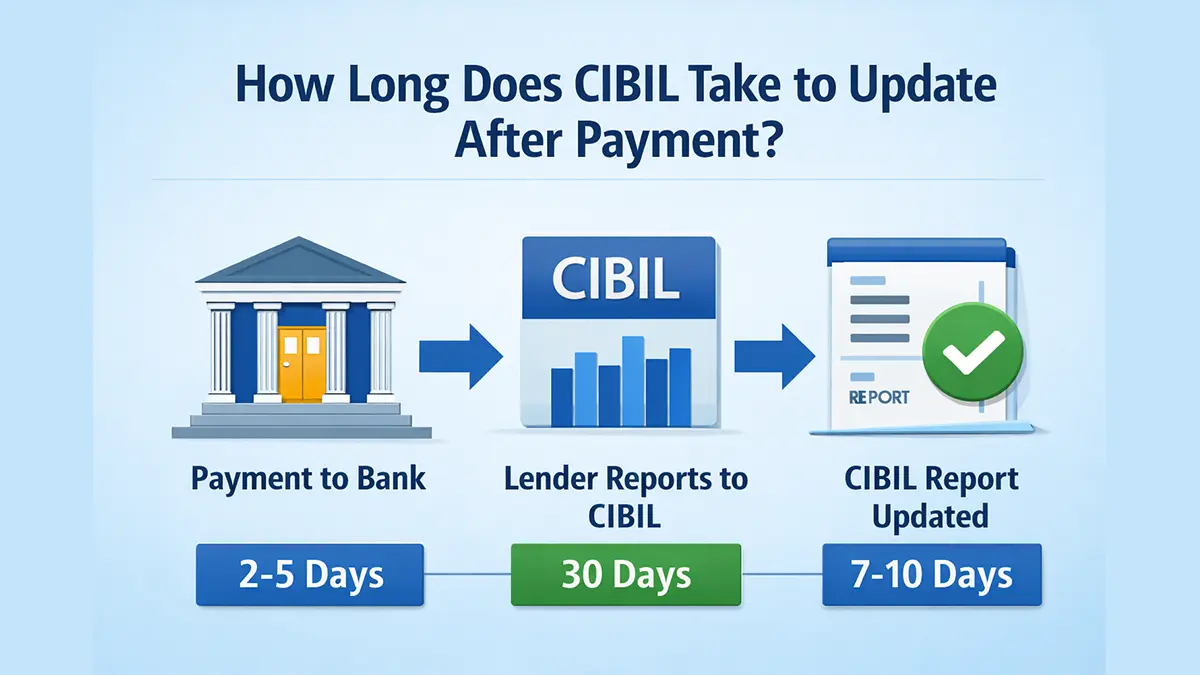
    Before we go deeper, let’s clearly answer the core question: how long does CIBIL take to update after payment in a typical Indian banking cycle?

    What Is CIBIL and How Does It Update?

    TransUnion CIBIL is India’s largest credit bureau. Banks and NBFCs report your loan and credit card data to CIBIL every month. Your credit score (ranging from 300 to 900) is calculated based on that data.

    Important thing to understand:

    CIBIL does not update your score instantly after you pay.
    It only updates when the lender reports fresh data.

    That reporting cycle is the real key.

    Standard Timeline: How Long Does CIBIL Take to Update After Payment?

    In most cases:

    30 to 45 days from the date of payment. This 30–45 day CIBIL update time is standard across most major Indian banks and NBFCs.

    Here’s why.

    Step-by-step process (what actually happens):

    1. You make the payment (say, 10 January 2026).
    2. The bank updates its internal loan system.
    3. The bank closes its monthly reporting cycle (usually end of month).
    4. Data is submitted to CIBIL.
    5. CIBIL processes the batch and refreshes your credit file.

    So if you pay on 10 January:

    • The bank may report by 31 January.
    • CIBIL may reflect it between 5–20 February.

    That’s why it typically takes one full reporting cycle.

    Real Borrower Example (Personal Loan EMI Case)

    Let’s say:

    • EMI due: ₹18,500
    • Missed EMI in December 2025
    • Paid overdue + penalty on 8 January 2026

    Now here’s what usually happens:

    • Bank marks December as “DPD 30” (Days Past Due)
    • January payment clears overdue
    • Bank reports updated status in end-January batch
    • CIBIL reflects update mid-February

    In practical terms, this means the CIBIL update after EMI payment usually follows the lender’s monthly reporting batch rather than the actual payment date.

    Score improvement? Possibly.
    But the DPD record for December stays in history.

    And this is where many borrowers get confused.

    Does CIBIL Remove Late Payment After You Pay?

    No.

    This is critical.

    If you missed a payment and later cleared it, the record remains in your credit history for up to 36 months (sometimes longer depending on reporting).

    However:

    • The status changes from “Overdue” to “Closed/Regular”
    • Your current standing improves
    • Future lenders see that you regularized the account

    In my experience, one isolated 30-day delay won’t permanently damage your profile — but repeated delays absolutely will.

    Credit Card Payment Case – Different Timing?

    Credit cards sometimes update slightly faster than loans because:

    • Card cycles are monthly
    • Reporting is automated
    • Some banks report mid-cycle

    Example:

    • Credit card outstanding: ₹52,000
    • Paid in full on 3 March
    • Statement date: 15 March
    • Bank reports on 31 March
    • CIBIL updates by mid-April

    But don’t expect score change within a week.

    Even though the payment clears quickly, the CIBIL score update after payment still depends on when the lender submits fresh data.

    That rarely happens in India.

    Loan Closure: How Long Does CIBIL Take to Update After Full Loan Payment?

    If you close a loan completely, timeline is similar:

    30–45 days

    But here’s something important.

    In my lending experience, banks sometimes take longer to mark “Closed” status internally — especially older accounts or manually processed closures.

    If you:

    • Closed loan on 5 February
    • Bank reports only in March batch
    • CIBIL reflects by late March

    That’s still normal. Many borrowers ask how many days CIBIL takes to reflect full loan closure, and the realistic answer remains within the same 30–45 day reporting window.

    If it crosses 60 days, then you should follow up.

    Settlement vs Full Payment – Major Difference

    This is where borrowers make costly mistakes.

    If you settle a loan for less than total outstanding (say ₹80,000 against ₹1,20,000), the account status becomes:

    “Settled”

    Not “Closed”

    That stays in your report and impacts future loan approvals heavily.

    Even after it updates, your score may not recover properly.

    In 2026 lending environment, most major banks:

    • Reject home loans if any recent “Settled” account exists
    • Ask for No Dues Certificate + explanation

    Payment timing is one thing.
    Settlement impact is another.

    Why Your CIBIL Score May Not Increase Immediately

    Many borrowers expect a big jump after clearing dues.

    Here’s reality.

    Score depends on:

    • Payment history (35% weight)
    • Credit utilization
    • Loan mix
    • Credit age
    • Enquiries

    If your score was 650 due to multiple missed EMIs, paying one overdue EMI won’t push it to 750 instantly.

    It improves gradually as:

    Even if you understand how long does CIBIL take to update after payment, score recovery itself follows a longer behavioral pattern.

    • Regular payments continue
    • No new delays occur
    • Utilization drops

    In my advisory work, I usually tell clients:

    Give it 2–3 clean reporting cycles before expecting meaningful improvement.

    When Does CIBIL Update Faster?

    Rare but possible in these situations:

    • Bank manually pushes corrected data
    • You raise dispute and lender responds quickly
    • System reporting error gets corrected mid-cycle

    Even then, it usually takes at least 15–20 days.

    Instant updates? No.

    Even in accelerated cases, the update timeline still depends on whether the lender pushes corrected data within the same reporting cycle.

    How to Check If CIBIL Has Updated

    You can check via:

    If you’re checking because you’re wondering how long does CIBIL take to update after payment, remember that updates only reflect after the lender’s monthly data submission.

    • CIBIL official website
    • Banking apps that show credit score
    • Third-party platforms

    But small advice from experience:

    Check only after 30 days.
    Checking too early only increases anxiety.

    What If CIBIL Is Not Updated After 45 Days?

    Now we move to problem cases.

    If:

    • You paid on 1 January
    • By 15 March it’s still showing overdue

    Then do this:

    1. Contact bank’s customer care
    2. Request reporting confirmation
    3. Ask for updated statement
    4. If unresolved, raise dispute directly with CIBIL

    In 90% of cases, delay is on lender side, not CIBIL.

    Banks report updated credit data to TransUnion CIBIL every month as part of their standard reporting cycle. According to the official CIBIL dispute resolution framework, updates reflect only after lenders submit revised data to the bureau.

    Myth vs Reality

    Myth: CIBIL updates instantly after payment.
    Reality: Updates happen only after lender reports monthly data.

    Myth: Paying overdue removes late history.
    Reality: Late history remains, but status changes.

    Myth: Paying full loan immediately boosts score by 100 points.
    Reality: Score change depends on overall credit profile.

    Practical Tips From 15+ Years in Credit Advisory

    Let me give you advice I usually give serious borrowers.

    1. Always pay 3–5 days before due date. Banks report based on due date, not payment clearance time.
    2. If closing loan, collect No Dues Certificate immediately.
    3. Avoid loan settlement unless absolutely unavoidable.
    4. Keep credit card utilization below 30%.
    5. Don’t apply for multiple loans while waiting for update.
    6. Track DPD column carefully in your credit report.

    Small discipline beats panic corrections later.

    Frequently Asked Questions

    How long does CIBIL take to update after EMI payment?

    Typically 30–45 days. That’s the standard answer to how long does CIBIL take to update after payment or after an EMI is cleared.

    Will my CIBIL score increase immediately after clearing overdue?

    Not immediately. Improvement reflects after next reporting cycle and depends on your overall credit profile.

    Does CIBIL update on weekends?

    No. Updates depend on lender data submission, not daily processing.

    How long does CIBIL take to update after loan closure?

    Normally 30–45 days. In some cases up to 60 days.

    Can I request faster CIBIL update?

    You can request lender to report early, but most banks follow fixed monthly cycle.

    If I pay credit card bill today, when will it reflect?

    Usually next statement cycle reporting — around 30 days.

    Does part-payment update faster?

    No. Reporting cycle remains same regardless of payment type.

    Final Advisory Perspective

    Here’s something I’ve observed repeatedly over the years.

    Borrowers worry too much about when CIBIL updates, and too little about why the score dropped in the first place.

    To summarize clearly: how long does CIBIL take to update after payment? In most Indian banking cases, expect one full reporting cycle — usually 30 to 45 days. That timeline is normal, not a delay.

    Credit scoring in India isn’t about one payment. It’s about behavior patterns.

    One missed EMI can be repaired.
    Three months of irregularity creates long-term credibility concerns.

    If you’ve paid your dues — good. That’s step one. Now focus on maintaining 6–12 months of clean repayment behavior. That’s what rebuilds trust with lenders.

    If you’re actively working on rebuilding your profile, here’s a detailed guide on how to increase CIBIL score fast with practical, real-world strategies.

    CIBIL updates are mechanical.
    Credit reputation is behavioral.

  • Minimum Balance Charges in SBI, HDFC & ICICI (2026 Updated Guide & Penalty Breakdown)

    Minimum Balance Charges in SBI, HDFC & ICICI (2026 Updated Guide & Penalty Breakdown)

    Minimum balance charges in India 2026 have changed across major banks like SBI, HDFC, ICICI, Axis, PNB and other public-sector banks. If you don’t maintain the required monthly average balance in your savings account, banks may deduct non-maintenance penalty charges automatically. These deductions may look small at first, but over time they can add up to thousands of rupees annually.

    In this updated 2026 guide, we break down bank-wise minimum balance rules, explain how penalties are calculated, compare public and private banks, and show practical ways to avoid unnecessary charges.

    Quick takeaways

    • Some public-sector banks have relaxed or changed how they collect minimum balance charges in India 2026, especially for basic savings accounts. Always check your bank’s official service-charges page for confirmation.
    • Private banks still commonly charge a monthly penalty for not maintaining the Monthly Average Balance (MAB); the penalty formula varies by bank and branch location.
    • If you want to avoid fees: convert to a zero-balance/basic savings account, link salary credits, or maintain a small buffer above the MAB.

    What is “minimum balance” (MAB / AMB)?

    To understand minimum balance charges in India 2026, you first need to understand how banks calculate Monthly Average Balance (MAB) or Average Monthly/Quarterly Balance (AMB) depending on account type and location (metro / urban / semi-urban / rural). If your balance falls below the required MAB/AMB, the bank may deduct a “non-maintenance penalty” or service charge. These requirements differ by:

    • Account variant (regular vs premium vs salary vs basic)
    • Branch category (metro/urban vs semi-urban vs rural)
    • Bank policy updates (some banks revised rules in 2025–2026)

    Minimum Balance Charges in India 2026 (Bank Wise Breakdown)

    Note: below are current public guidance and commonly reported penalty formulas (always confirm on your bank’s official “fees & charges” page before assuming a number).

    State Bank of India (SBI)

    SBI has revised its non-maintenance penalty structure multiple times in recent years, and many basic savings account variants currently show reduced or waived minimum balance requirements. on certain account types, but its public service-charges pages show waivers/changes for many basic savings accounts (and SBI’s published service-charge documents are the authoritative source). Because SBI periodically updates its service schedule, check SBI’s official “revised service charges” page for the exact current slab for your account.

    HDFC Bank

    HDFC lists MAB/AMB requirements and fees for each savings account variant on its fees page; private banks like HDFC typically have tiered penalties with fixed monthly charges for shortfalls and different slabs by location and account type. For exact penalty slabs, refer to HDFC’s official “fees and charges” page.

    ICICI Bank

    ICICI publicly states that penalties for failing to meet MAB are either a fixed amount (for many account types) or a percentage of the shortfall (commonly ₹500 or 6% of shortfall — whichever is lower — in older published guidance). Confirm the current slab for your account on ICICI’s fee schedule.

    Axis Bank

    Axis publishes a fee master where penalties are shown as either a percentage of the shortfall (e.g., ₹6 per ₹100 shortfall) or a fixed minimum (e.g., ₹150), depending on account type/location. These formula-style charges are common for private banks.

    Punjab National Bank (PNB)

    PNB, like other PSBs, varies penalties by account variant and branch category; recent government/Parliament disclosures show PSBs still collect significant sums from non-maintenance charges overall. Always check PNB’s latest schedule for exact values.

    Bank of Baroda (BoB)

    Bank of Baroda announced (public-facing site) that it has waived minimum-balance charges on most savings schemes w.e.f. 01.07.2025 (excluding certain premium accounts). That means many BoB customers no longer face routine non-maintenance penalties — but check your account variant to be sure.

    Bank of India

    Bank of India’s public pages show many ordinary savings variants with no current minimum-balance charge for basic accounts — again, verify the specific product.

    Minimum balance charges in India 2026 bank comparison table

    The table below compares minimum balance charges in India 2026 across major public and private banks along with simplified penalty formats for easy comparison. For the exact ₹ values and slabs for your account, always check the bank’s official fees page linked in the notes.

    BankTypical Minimum Balance (Metro)Penalty StyleExample Shortfall ImpactZero Balance Option Available?Best ForRisk Level If Ignored
    Axis Bank minimum balance charges₹10,000₹6 per ₹100 shortfall OR minimum feeIf ₹2,000 shortfall → approx ₹120–₹150 + GSTLimited (mostly salary accounts)Salaried professionalsMedium
    HDFC Bank minimum balance charges₹10,000Slab-based monthly penalty₹3,000 shortfall → penalty as per slab + GSTYes (salary accounts)Urban account holdersMedium–High
    Indian Bank minimum balance charges₹2,000–₹5,000 (varies)Scheme-based penaltyLower penalty compared to private banksYes (basic savings accounts)Small town / rural customersLow
    Bank of Baroda minimum balance chargesMostly waived (after 2025 for many schemes)Minimal or no penalty (standard accounts)Many customers face zero chargeYesCost-conscious usersVery Low
    SBI savings account minimum balance and chargesVaries by account typeMostly removed for basic savingsMany accounts no longer face penaltyYes (Jan Dhan & basic savings)Mass banking customersLow

    (Table shows formats — always confirm your exact product slab)

    How the penalty is calculated?

    Imagine your MAB requirement is ₹5,000 (metro/urban). On the last day of the month your average balance is ₹3,000 ⇒ shortfall ₹2,000.

    • If the bank charges a flat penalty, you might pay e.g., ₹150 for that month.
    • If the bank uses a percent of shortfall (Axis-style example at ₹6/100): penalty ≈ ₹120 (₹6 × 20) or the stated minimum (whichever applies).
    • If ICICI-style rule applies (₹500 or 6% of shortfall, whichever lower), then 6% of ₹2,000 = ₹120 (so you pay ₹120).

    Remember GST may be applied to service charges in some cases.

    Does minimum balance affect CIBIL or credit score?

    Short answer: usually no. Minimum-balance penalties are a bank service charge on your deposit account. They do not directly report to credit bureaus the way unpaid loans or credit card defaults do. However, repeated overdrafts or bounced transactions that cause loan EMI or credit card payments to fail could indirectly harm your credit profile. Always keep enough buffer to avoid knock-on effects.

    However, if low balance causes EMI bounce or missed loan payments, it can indirectly affect your credit score. You can read our detailed guide on how to increase CIBIL score fast to understand practical recovery steps.

    How to avoid minimum balance charges

    Avoiding minimum balance charges in India 2026 is easier if you understand your account type and maintain a small buffer.

    1. Switch to a zero-balance/basic bank account if you qualify (e.g., Jan Dhan, basic savings, or specific ‘zero MAB’ products).
    2. Link your salary/pension to the account — many salary accounts have no MAB.
    3. Move to a digital/neo bank product offering zero MAB or minimum deposits (but check service coverage).
    4. Maintain a small buffer — always keep ₹500–₹1,000 above required MAB to avoid accidental shortfalls.
    5. Use standing instructions or auto-sweep from a linked savings/fixed deposit to maintain balance.
    6. Opt out of paid services (SMS packs, paper statements) that add to monthly fees.

    What to do if a charge feels wrong

    • Check your account’s product terms (passbook or online product page).
    • Ask the bank for a breakdown (branch or call centre).
    • If your complaint is not resolved by the bank, you can escalate the issue under the RBI Ombudsman Scheme available on the official Reserve Bank of India website.

    Frequently Asked Questions

    Is my Jan Dhan account exempt?

    Yes, most Jan Dhan and basic savings accounts are zero-balance by design. Check your product terms.

    Do senior citizens get relaxations?

    Some banks offer concessions; product pages or branch staff can confirm eligibility.

    Are MAB rules same across India?

    No — they differ by branch location (metro/urban/semi-urban/rural) and account variant.

    BoB waived the minimum balance charge — is that permanent?

    Bank of Baroda publicly announced waivers on many savings schemes effective 01.07.2025; this reduces fees for many customers, but premium products may still have rules. Always check the bank’s service-charges page for the latest.

    Understanding minimum balance charges in India 2026 can help you choose the right bank and avoid unnecessary penalties throughout the year.


    This article is based on publicly available service-charge disclosures from major Indian banks and RBI regulatory guidelines applicable in 2026. Always verify the latest slab applicable to your specific savings account variant before assuming a charge.

  • Missed Loan EMI in India (2026 Guide): Charges, CIBIL Impact & Legal Consequences

    Missed Loan EMI in India (2026 Guide): Charges, CIBIL Impact & Legal Consequences

    Missed loan EMI in India can lead to late payment charges, bounce fees, credit score damage, and in serious cases, legal recovery action. While one delayed payment may not seem serious, ignoring a missed loan EMI in India can create long-term financial consequences.

    In this 2026 guide, we explain what happens after an EMI is missed, how much penalty banks charge, how it affects your CIBIL score, and what steps you should take to protect your credit profile.

    What Happens After a Missed Loan EMI in India?

    If your EMI auto-debit fails due to insufficient balance, the lender (bank or NBFC) typically:

    1. Marks the transaction as failed
    2. Applies an EMI bounce charge
    3. Adds late payment interest
    4. Sends SMS/email reminders
    5. Reports overdue status in the next billing cycle

    Most lenders report repayment behavior to credit bureaus such as:

    • TransUnion CIBIL
    • Experian India
    • Equifax India

    If the payment remains unpaid beyond the billing cycle, it may be reported as DPD (Days Past Due).

    EMI Bounce Charges in India (2026)

    When your EMI auto-debit fails due to insufficient funds, lenders apply a bounce charge.

    Typical bounce charges:
    ₹300 – ₹750 + 18% GST
    (Varies by lender and loan type)

    Example

    EMI Amount: ₹8,000
    Bounce Charge: ₹500
    GST (18%): ₹90

    Total payable next cycle: ₹8,590

    Repeated bounce events increase overall cost and may negatively impact your repayment record.

    Late Payment Penalty (Overdue Interest)

    Late payment penalties are separate from bounce charges.

    If EMI is paid after the due date, lenders may charge:

    2% – 4% per month on overdue amount
    (Some lenders calculate daily)

    Example

    Overdue EMI: ₹10,000
    Delay: 10 days
    Additional penalty may range between ₹300 – ₹600 depending on policy.

    Always check your loan agreement for exact penalty structure.

    What Happens After 30, 60 or 90 Days of Non-Payment?

    Banks report repayment behavior using DPD codes:

    Days LateCIBIL StatusMeaning
    0 Days000No delay
    30 Days0301 EMI overdue
    60 Days0602 EMIs overdue
    90 Days090Serious default

    30 Days Delay

    • Visible impact on credit report
    • Possible drop in credit score

    60 Days Delay

    • Larger score reduction
    • Aggressive follow-up from lender

    90 Days Delay

    • Account may be classified as NPA (Non-Performing Asset)
    • Strong negative credit impact
    • Recovery action may begin

    How a Missed Loan EMI in India Affects Your CIBIL Score

    CIBIL score range: 300 – 900
    Good score in India: 750+

    One missed EMI can reduce your score by approximately 50–100 points, especially if:

    • You have short credit history
    • You have high credit utilization
    • You have previous delays

    Repeated missed payments can push your score below 650, making future loans expensive or difficult to obtain.

    Negative entries can remain on your credit report for up to 7 years.

    If your score has already dropped due to a missed loan EMI in India, you can follow our step-by-step guide on how to increase CIBIL score fast to understand practical strategies for rebuilding your credit profile.

    Legal Consequences of Missing EMI

    Legal action depends on loan type and default duration.

    Personal Loans & Credit Cards

    • Recovery calls begin
    • Legal notice may be issued after prolonged default
    • Settlement offers possible (but impacts credit score)

    Home Loans (Secured Loans)

    If default exceeds 90 days, lenders may initiate recovery under the SARFAESI Act.

    This may include:

    • Legal notice
    • Asset seizure process
    • Property auction (in extreme cases)

    Vehicle Loans

    Extended default may lead to repossession following due legal process.

    Ignoring EMI for long periods increases legal risk.

    RBI Rules on Recovery Practices

    As per guidelines issued by the Reserve Bank of India (RBI):

    • Recovery agents cannot use abusive language
    • Public humiliation or harassment is prohibited
    • Calls should not be made outside reasonable hours (generally 8 AM to 7 PM)
    • Charges must be clearly mentioned in the loan agreement

    Borrowers can escalate complaints through:

    1. Bank grievance redressal officer
    2. RBI Integrated Ombudsman Scheme
    3. RBI Complaint Management System (CMS portal)

    Official references:

    Always verify updates directly on the official RBI website.

    Can You Remove a Missed EMI From CIBIL?

    If the delay was genuine and reported correctly, removal is difficult.

    However, you can:

    • Clear all outstanding dues
    • Maintain 6–12 months clean repayment history
    • Raise dispute if reporting error exists
    • Request lender correction after full settlement

    Consistent repayment behavior helps rebuild score over time.

    What If You Cannot Pay EMI?

    If facing financial hardship, consider:

    • Loan restructuring
    • Temporary moratorium (if available)
    • Balance transfer to lower interest loan
    • Discussion with lender

    Settlement is a last option.

    Important:
    Settlement status reflects as “Settled” in credit report and may affect future loan approvals.

    EMI Bounce vs EMI Default (Key Difference)

    EMI BounceEMI Default
    Payment failed due to insufficient balanceEMI unpaid for 30+ days
    Bounce charge appliedCredit bureau impact confirmed
    Can be corrected quicklySerious credit damage
    Short-term issueLong-term consequence

    Bounce is technical.
    Default is credit damage.

    Frequently Asked Questions

    What happens if EMI is missed by 1 day?

    Usually no big issue. But some banks still charge penalty. Better pay immediately.

    How much are EMI bounce charges in India?

    Normally ₹300–₹750 + GST per bounce.

    Does 1 missed EMI affect CIBIL?

    Yes, if reported as 30 DPD. Score drop ho sakta hai 50+ points.

    Can bank file case for EMI missed?

    Yes, after continuous default. Especially home loan & secured loans.

    How many EMI missed before legal action?

    Usually after 90 days default serious action start hota hai.

    How to Avoid Missing EMI in Future

    • Maintain emergency fund (3–6 months EMI amount)
    • Set EMI date after salary credit
    • Keep balance buffer before due date
    • Use calendar reminders
    • Avoid over-borrowing

    Financial discipline protects your credit profile.

    Final Words 2026 Advice

    A missed loan EMI is not the end of your financial life. But ignoring it can damage your credit profile, increase costs, and create unnecessary stress.

    If a payment is missed:

    • Clear dues immediately
    • Contact your lender
    • Confirm payment update
    • Monitor your credit report

    Your repayment history directly impacts your future borrowing ability.

    Understanding how a missed loan EMI in India affects your credit report can help you take corrective action before long-term financial damage occurs.


    This article is written based on RBI guidelines, Indian banking norms, and credit bureau reporting standards applicable in 2026. For case-specific advice, consult your bank or a certified financial advisor.